

Hot brittle heads
Dogs, frogs and my Scotch Lass reading era

I know, I know, I’m supposed to get up and swallow the frog but I also need to walk the dog and that’s pure pleasure, mostly, and on normal days which this absolutely doesn’t feel like; more menacing Hitze, hideous sticky and cranky apocalyptic air. Everything feels, well, off. The dog has become the frog and my throat doesn’t want to swallow him. Much less kiss him when he turns into the prince I’m quietly avoiding ever meeting. It’s all feeling too extreme, I’m disoriented and I don’t want to do the usual, habitual things.
Walking the dog today in this rising swelter will mean an uphill scrabble over chalk land amongst ancient spiky yews rooted and pitching out beyond the steep, dry slope of the Ashford Hangers. A canopy of shady green, yes, but with stark ash dieback left standing to tower in just their naked bark. Giant zombie hands reaching up into the sky from their rocky graves.
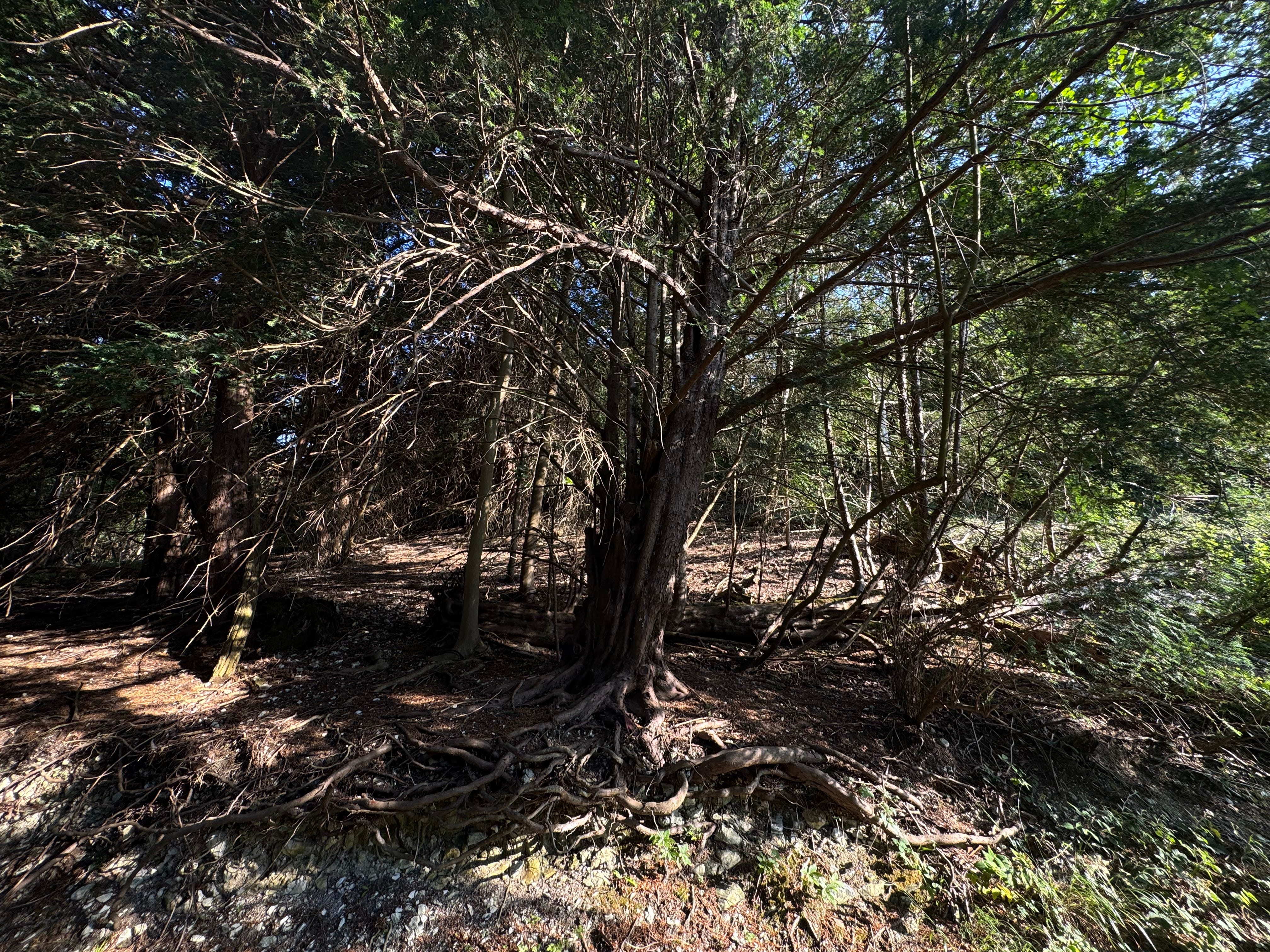
And I don’t want to walk a dog or frog or even walk myself anywhere at all; I was out pacing the very same route at ten pm last night and it’s all feeling like a big, hot repetitive suffocation of a chore. Like the pandemic one hour allotted walk a day. And I am someone who loves to cover miles on foot.
The dog/frog does in fact regularly turn into a proper prince alright, up there in that landscape. Prince IDGAF of Low-Desire-to-Please Kingdom. Nose to the ground and the scent of whichever critter turned carcass is fermenting in the undergrowth due to an entirely natural and normal end. It’s his nature too after all. He is dog. He leaps off the trail following the whiff and is go ….
An extra fifteen minutes of pathway loitering I reason I can do without this morning. Shuffling feet, sweating and huffing for him to break his forest silence with a black and white bounce back to colour on the trail. It’s irritating, the waiting. What’s really going on though in lost minutes of his absence when he pulls this trick on me is not really irritation at all; it is a colossal and catastrophic warping of time and back to another dog who in such extreme temperatures would be triggered into epileptic seizures so profound that they killed him ultimately and while still very young.
I suppose I’m trying to distract myself with surface feelings of irritation from what is underneath a fierce fear that he will disappear forever in the undergrowth and not come back and that I’ll lose him to the heat and he will die the same as the first dog did. The OG dog. The Dogfather, the generous, bronze giant who loped into our life to lead us towards our big, beating hearts all broken and filled with gaps and holes and scars and not simply the missing sphincters and ventricles of the baby.
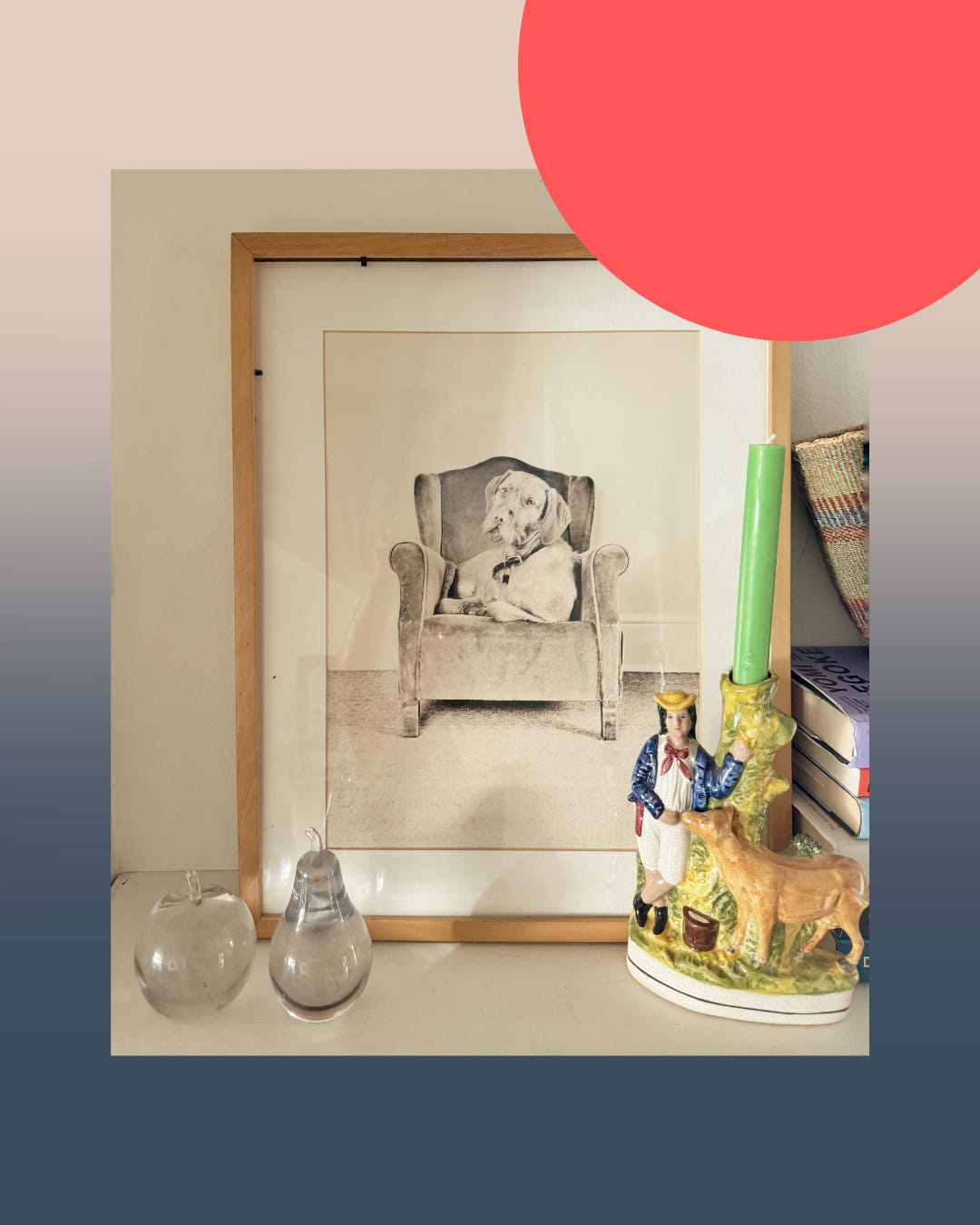
No, this morning I avoid the frog and the dog both and slide myself instead horizontal on to a purple mat in the shade of the fence. A pair of fat, hungry pigeons are clattering their wings above me perched. The tap is cranked open, the hose a slithering snake of yellow guilt and I notice a trickle of this flows in rhythm with the water meant for astrantia roots twisting down into new soil. With a sip of acrid coffee I pick it up, this book. Ootlin it’s called.
ootlin ; stranger, foreigner, outcast, exile /ˈut.lɪn/
A Scottish word for someone who doesn’t belong.
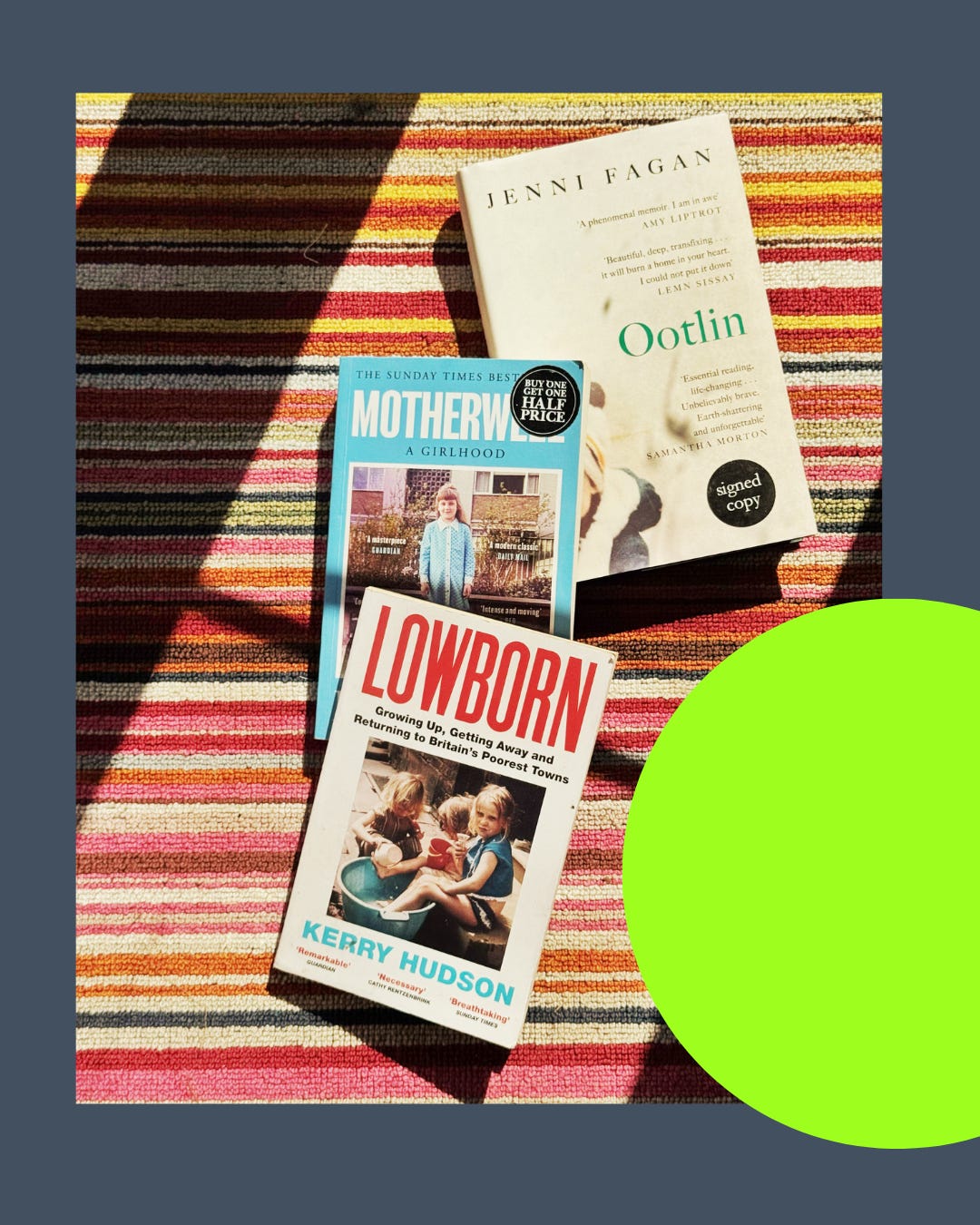
I’m in my Scotch lass reading era, clearly. It took me seeing this pile of tbr and just read books to notice this. It all started up in Orkney with Amy Liptrot - her two books are upstairs and soon to become three - then moved south east towards Aberdeen and Kerry Hudson, shifted west across to Deborah Orr in Motherwell and now here I am with Jenni Fagan. An accidentally gallas gambol over Scotland in words. These are each unforgettable and poignant memoirs and full of skilfully crafted observations burnished now into my mind and, without turning this piece into a book review, go read them. That said, the young girls here are not skipping lightly in gently scuffed Mary Janes across the pages of their childhood, the ice cream van horn the only sound off; at times things become profoundly tough for each and their truths involve some brutal lived experience.
At the time this book published, I knew the hype around it and my eyes frequently landed on its creamy hardback cover on bookshop tables. Then life. Later still, I would listen in to an episode of The Shift and a conversation between sam baker and the writer ( a link to this below 👇🏼 ) and also an episode of Take Four Books too and I would notice how gorgeously the author’s voice seemed to lilt along and I’d recognise an emphatic steadiness in Jenni Fagan’s words. I knew nothing about her life at that point and yet she was already making a strong audio impression on me.
And then more life. And, eventually, recently only, a copy of the book did finally find me and in the town’s Oxfam bookshop. A hardback copy and signed too. So now, today, as well as guilt for reading at 8:00 am, for not walking the dog first thing, for not swallowing the frog, for watering a part of the garden in a heatwave, I am also drenching myself in guilt for not having paid the full RRP for her words. For these words.
They took me - away from me. The only thing I arrived here with is gone and I have to answer to a new name now.
When I arrived here I was someone.
They didn’t like it.
She wanted a Jenny.
Sixty pages in and I am already sodden with love for the kid on these pages. Choked by the broken system she was systematically broken and broken and broken and broken on repeat by. Humans entrusted with but mostly not worthy of her care.
The dog just pissed up my dahlias and ants are ravaging my bare, straddled limbs in scratchy morning shade as I read chapters and my eyes take in the light of her story; insects and urine, bothersome at most and also nothing at all other than the faintest.
A message pings on my phone. Is it from him? I’m scared about him in this heat and so far away. I have a need to know he has a cap for his head, at least SPF 30 on his skin and enough water. It is from him, this message, and I let it interrupt my reading because, out of sight only not mind. This time last year he was indefinitely here and that was my problem. Now though, and somewhat fabulously, he’s 150 miles away and living his best college life ..
The words he has typed to me are confusing and make barely any sense or at least, they wouldn’t to you or to anyone other than perhaps his oldest sister who might be able to discern the context as I just about managed to.
He’s not delirious and he’s not in danger and he’s not drunk either and it’s still almost a nonsense what he has written but isn’t quite; it’s a scene from a favourite film though how is he sending these words in response to the rational request I sent to him, it beggars.
When the dog - the O.G. dog - died he looked for him for two years relentlessly. Every day, every where. On repeat and wherever we went. Urgently trying to locate him, the dog that had just disappeared. Not knowing that things are until they are not.
This version of caring at a distance is unsettling and new to me. He is and yet he is also not. He is somewhere but he is not here. He is alive and he is in a place I can’t see him or work out what his needs are or feel his feelings or translate his needs or chivvy or check in. Is this perhaps for me as difficult as for him the notion of a death, a disappearance, an ending I wonder.
Unsure of what to do with his wild words, I flip the phone into the grass. Dismiss it. I’m annoyed at the interruption. I pick up Ootlin.
… In her bedroom next door the adopted mum has more dolls than I have ever seen in my life. They all stand with super-straight backs and perfect hair and porcelain skin and they never get angry and I am not allowed to do that either. If I do I am to go to my room and come back when I’ve put a smile on my face…
A sack of knowing rocks lands in the pit of my stomach reading these words; bad things are about to appear on the page, I sense it. And these dolls can only mean danger. Dolls always mean danger in prose.
I drop the book and march inside the house to plug in and power up the phone and also to put distance, yet more of it, between him and I. I want to be with the small girl in the caravan and not with the small boy / man who I can’t care for properly or sense at all. The girl is more alive to me than the boy in this moment. I almost walk away from the socket without doing it but then I do it, I magic a manipulation and type it into the glass.
“It’s someone’s birthday today, do you know whose birthday it is?”
I’m baiting him in desperation. He has a photographic memory for birth and death dates and idolises David Hockney. Today, the prodigious British artist I once met on a plane would’ve been 89. This is my lure and I dangle it down the fibre optic line to hook him.
Sometimes I take him to the second hand bookstore with the bearskin on the ceiling and the Gene Simmons mannequin standing sentry to a giant vitrine of old toys with cold stares and where a man with skin punctuated by silver spikes and blue ink and always blue clothes with a football club in his name sells ancient maps, books and prints from a creaky labyrinth of dusty rooms.
The first time we paid a visit I lost him inside whilst scouting for Hockney anthologies and then found him with his phone at the end of his nose taking dozens of pictures. Pale-faced dolls with pain painted over their brittle porcelain faces and the soft-faced blue man standing next to them.
“These all belonged to my Mother” he was explaining to my son. There is no part of his face that is not tattoo this man speaking about dolls.
“Does that mean you are the Director of the Dolls” Jake asks as I walk over towards them.
I loved witnessing this gentle, curious interaction between my kid and this man who many may consider to be dangerous-looking.
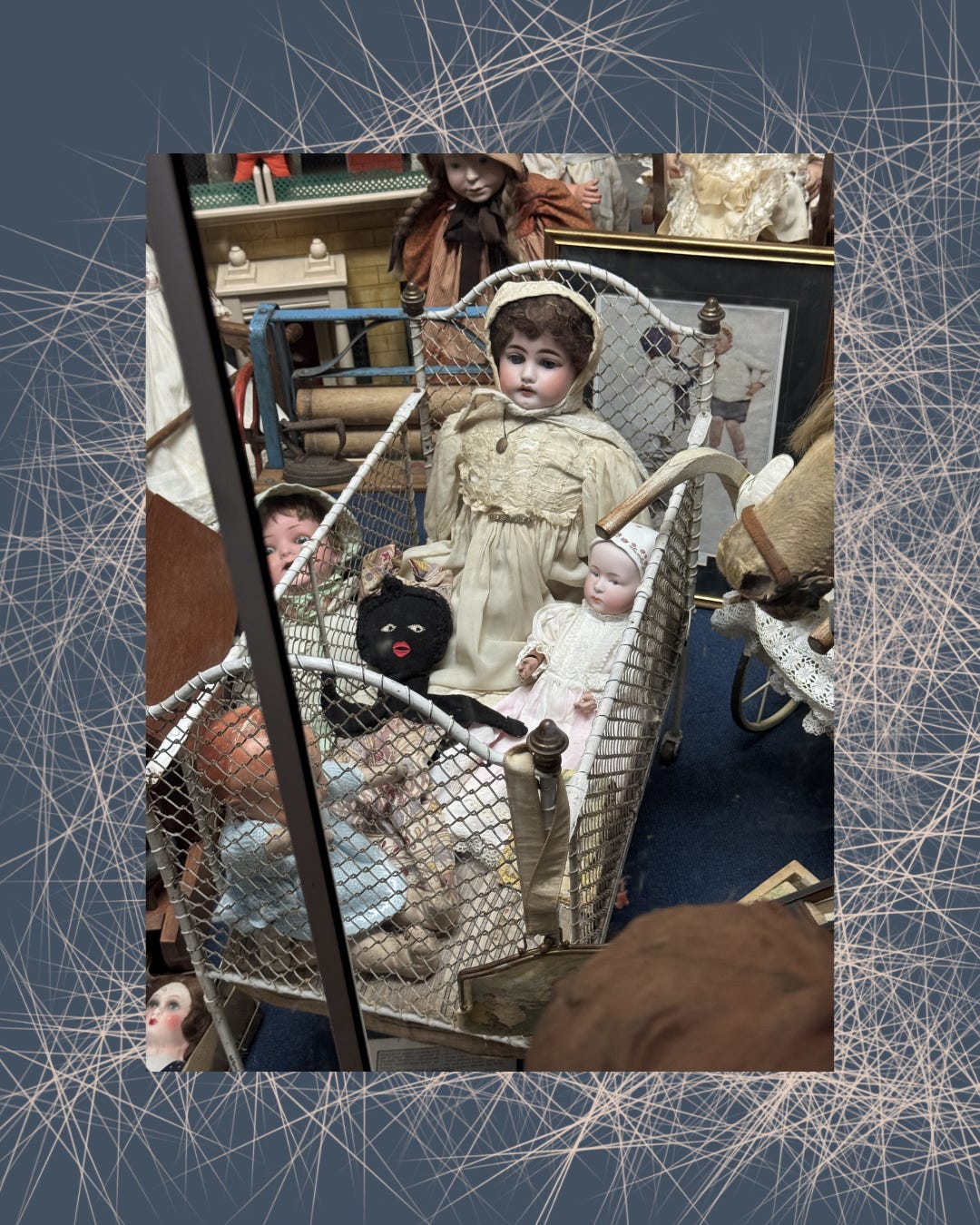
Dolls. They have connotations don’t they. Even a newborn baby is looking at a face and trying to discern whether there is a mind behind it. It’s primal to do this.
In 2010, Thalia Wheatley1, a cognitive neuroscientist at Dartmouth University studied our responses to dolls to investigate a simple skill we all have, but one which was a lingering mystery in neuroscience: How exactly do we tell a who from a what? And what can a doll tell us about this confusing process?
Wheatley showed Dartmouth students a series of images morphing from a doll to a human baby, with many in-betweens and some would say Jeff Bezos’ baby chops amongst them. “We knew that one endpoint was a doll, and the other endpoint was a human being,” she says. “The question was whether there’d be any consistency in when people determined it slipped from one to the other.” The results of this study are here.

The horror genre and the expressions that each successive generation of arguably twisted toymakers deem appropriate to project onto the frozen in —* insert adjective*— doll faces to incite a child into play, they intrigue and frighten in equal measure.
Surely no face at all is better and more ‘playful’ for a kid than a permanently fixed face which looks insane if you ask me and I know that you didn’t. Plus those awkwardly blinking eyes and overly long lashes, do they do anything at all to suspend disbelief.
Folk dolls used to be made without facial features before mass production, and this feels more play-focused and less freaky to me by a stretch. I don’t have the data to support any of these assertions and also, by definition, emotion is energy in motion and emotions must move. Otherwise, it’s uncanny valley all the way.
Anyway, whoah there Sarah, pull back the reins on that doll dray horse deep dive gallop for a second. You were reading, you were interrupted and also you were and are on the cusp of a long summer of care so best crack on.
My heart knows that soon he will be back, my son. That 24/7 care will resume and August will unroll itself and spill these curious moments and book shop interactions all over my days. And we will also have our three hefty Hockney books to dip toes into - alas, no pool - and to colour our dreams should sleep even come to us at all in this heat.
So I’d best read on now whilst I can. Divert the flow of guilt elsewhere though not underground.
I think of him elsewhere today and force some trust into my mind, leave the phone at the wall and the future and some fears and head back out to the garden, to the mat, to Ootlin and to be with the little girl in the caravan who can’t leave.
And simultaneously I wonder how the hell Jenni Fagan ever managed to find trust anywhere at all in the world. I’m already reasoning that this is a miracle.

TEDX Thalia Wheatley on how we perceive minds and dolls