


On Sunday, close to Glastonbury Tor, I witnessed a celestial spectacle and one I’ve been yearning to see in the real again with my own eyes. It felt risky to travel there but the risk paid off and, afterwards, I steered myself home impersonating someone who knew what she was doing.
The last time they stunned me with their aerobatic displays was just after the pandemic travel restrictions lifted and in southern France, on a late September evening. I was in the Entre-Deux-Mers region close to Bordeaux, to photograph the grape harvest.
There, they performed against a backdrop of rosé sky and with heavy window shutters for stage curtains framing my loggia box view from the bedroom in the (former) French convent where I was staying.
Sunday’s sky theatre was standing room only and colder in temperature though not at all in mood.
I’d followed the route to RSPB Ham Wall after dropping a son at a faraway place, calculating that, to visit this wetland wildlife sanctuary on the return leg of the journey would not be an impossible detour to make. I factored I’d have the energy to manage the drive home in darkness. For this kind of fabulous.
Arriving slightly early for the big show, I got myself a coffee from one of the volunteers in the shed who confused me by asking if I wanted Dairy Milk with it. What, in my coffee? I spluttered. She meant dairy milk not Dairy Milk and as opposed to oat milk but that’s not how my ears heard it.
I went with my not chocolatey coffee for a wander along the waterside trails and to check out the various hides. The afternoon light was golden and a bitter though thankfully gentle north wind was blowing the reeds into silvery shimmering, rustling shapes which were beautiful in their own right. I wasn’t there to see them though, my want was for more than pale swaying vegetation.
A flock of Golden Plover all together bobs in an apparent line though it isn’t one on the still water. A glossy, black sliver of cormorant glides just metres over the pathway ahead and, later, a hefty Great White Egret drops down to feed in the waters of the canal, legs dangling. Even before parking the car, I’d had to pull over suddenly against a corrugated barn to ogle the cream-feathered hulk of a marsh harrier which had casually landed on a roof to the left of the road.
I’d already been treated to a lot of bird activity whilst waiting for the sky dancers themselves to arrive. The mimics. The star performers. The starlings who are overwintering amongst the reed beds, some half a million birds, and twirling their daily dusk dance through until late February. But, as I said, I was in yearning for this so was feeling mighty greedy and knew I’d be far from content if they just happened - as is regularly the case - to do their murmuration miles away and in the distance out of sight. I can’t fake gratitude very easily and especially not in this cold; that’d be being faux-kay, as Sara Pascoe just described faking a response on the radio quiz I’d been listening to whilst driving to the sanctuary.
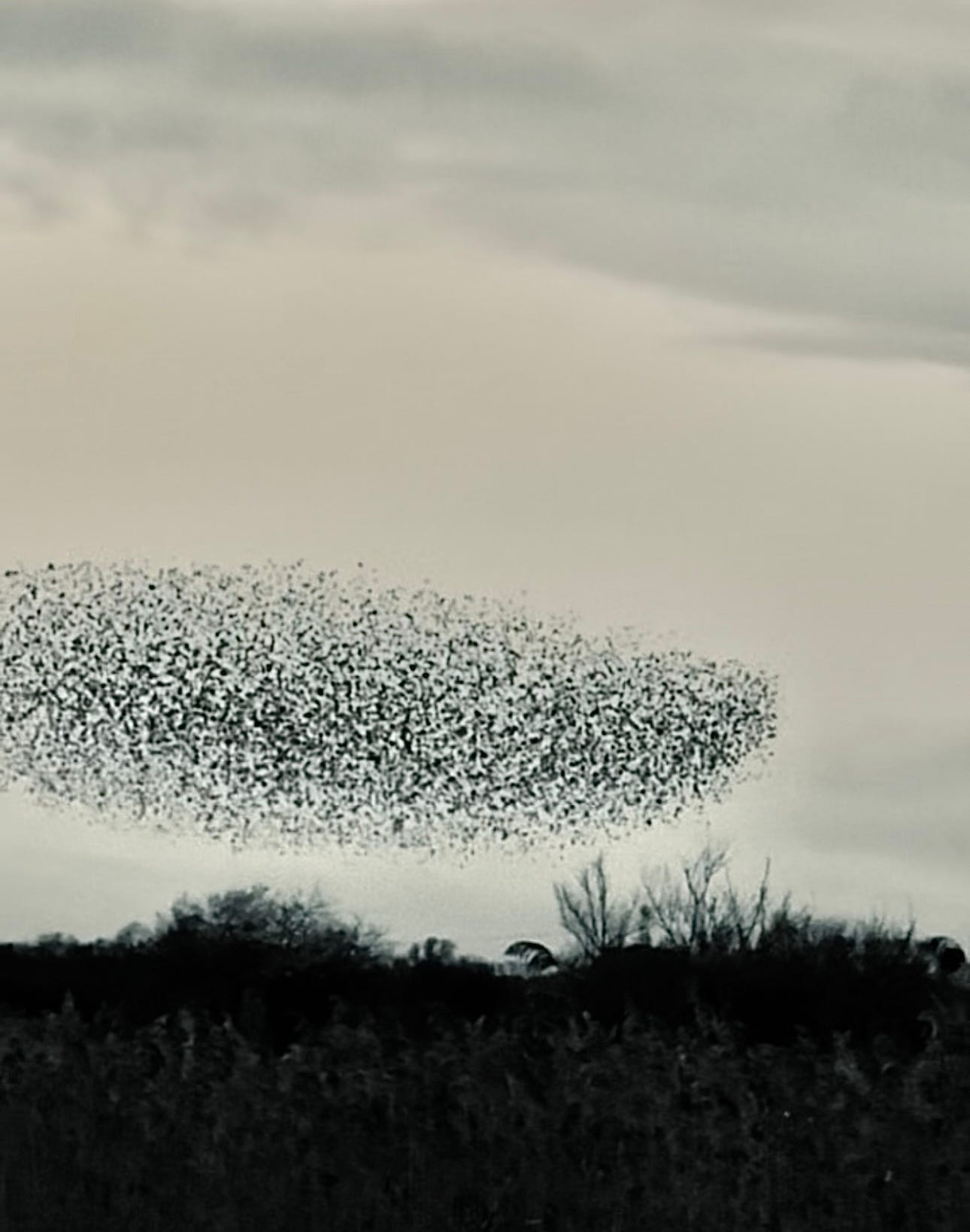
Starling murmurations have long mesmerised me and particularly through the captivating pictures of Icelandic photographer Søren Solkær. It’s not just giant hive mind displays these birds excel at, they’re also able to mimic the sounds of not only other birds but also mechanical machinery like lawn mowers and strimmers.
Though I’m a photographer too, on Sunday, I had nothing with me but a phone and a full battery charge. Plus shoulders and arms as a stiff and bony tripod to steady my filming despite the temperatures hovering much lower than any birds. And hope.
Hundreds of us gather in bulky, cumbersome layers of down jacket and fleece trousers, flapping our hands and lifting and lowering cold feet along the banks of Glastonbury canal. A pair of young boys pass me lugging giant camera rigs with lenses longer than my actual limbs and I felt a mimic myself in that moment, stood with just a tiny slab of shiny smartphone.
Dozens of expectant watchers are assembled to the left of me and dozens similarly to the right and, in either direction, the lines continue into the distance.
Couples chatter, friends catch up on life, parents chastise short, twitchy legs on scooters for veering too close to water and ankles. And toddlers, strapped into prams make their rigid, teddy-shaped protest winces.
And I wonder, how it is that we’re all gathered in celebration of birds flying freely between landmasses and choosing to change their home when the conditions threaten wellbeing and survival, when resources run low. Yet when humans do the same, it’s around hotels that we gather, not to celebrate and it’s not the babies in prams making noisy protest.
And, just as the golden disco ball of life begins to lower behind the ridge, they all take flight from beyond the wetland and lift up into the peachy glow.
They ripple for half a clock hour across the horizon and wow us from the air with their liquid twists and bulging braids of beautiful, tumbling, tubular polka dots. Repeatedly shapeshifting and reassembling themselves into new, lofty undulations.
I only manage to capture this all in clunky, crackly and necessarily magnified footage because, cold fingers. A cirque de soleil playing out against the actual soleil and prompting similar spirit-lifting oohs and aahs.
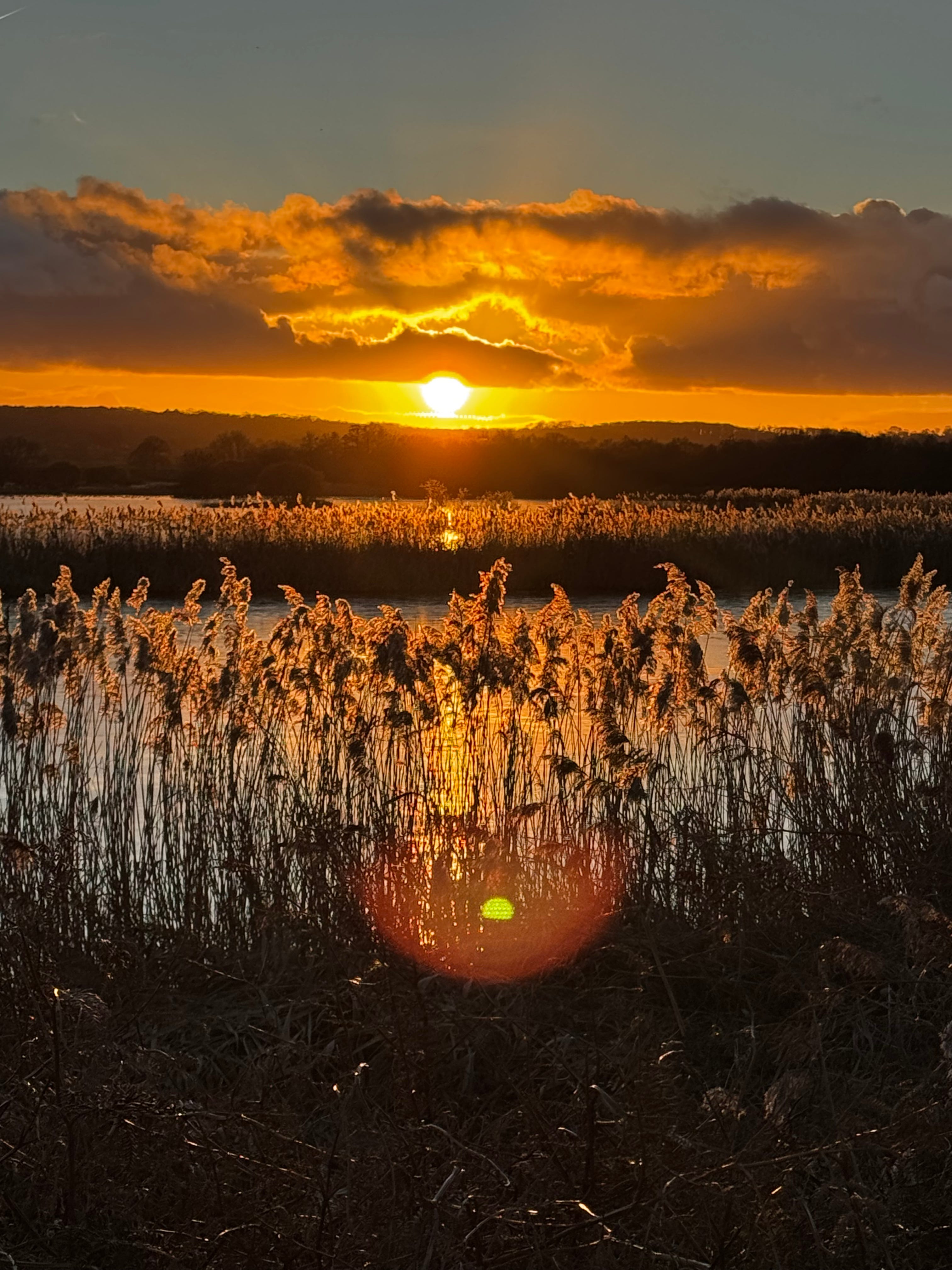
I swear I could feel some of the sun’s orange glow in the pit of my stomach as I went to sleep that night. A little of the heat and thrill warming the cold space left by the leaving of him, my boy, faraway and growing big life shapes of his own at college. A miniature migration of sorts, that too. And the impersonation of his mother I’ll need to become in the meantime, without prompts or refrain or reminders to care for him and watch over his safety. To mimic not caring just well enough to get along with doing other things. Yet to also remember precisely how to turn myself back into that mother too. A clunkier dance entirely. It’s the third time in three months that I’ve taken and left him to be cared for solely by others and, after twenty years of not doing that, it’s a hefty adjustment. The internal shifting makes shapes of my stomach which seem to mirror the billowing swirls and tubular funnels the birds made in the sky.
I’m going to try to go back to Ham Wall next month, before the starlings migrate back to colder parts of Europe to breed. I have to return to Somerset, in any case, to collect the boy again. We’ll doubtless make a pit stop on the A303 at Teals which he calls Tales and nourish ourselves with good food for the journey. We’re free to do this. The starlings too, they’re free to land where they chose to land. I feel for humans who aren’t able to make these choices for themselves, without such freedoms and can’t stop thinking of the billionaires who fix their individual focus on flying rockets into space and hot air balloons.
The murmurations are a giant phenomenon to behold and share and it costs all of four quid in parking fees which is also significantly cheaper than the actual human cirque de soleil acrobatics. No shade on the cirque though, as I love their shows very much too.


